A Tribute to James W. Clark, DDS
by
Preston. D. Miller ,JR. DDS
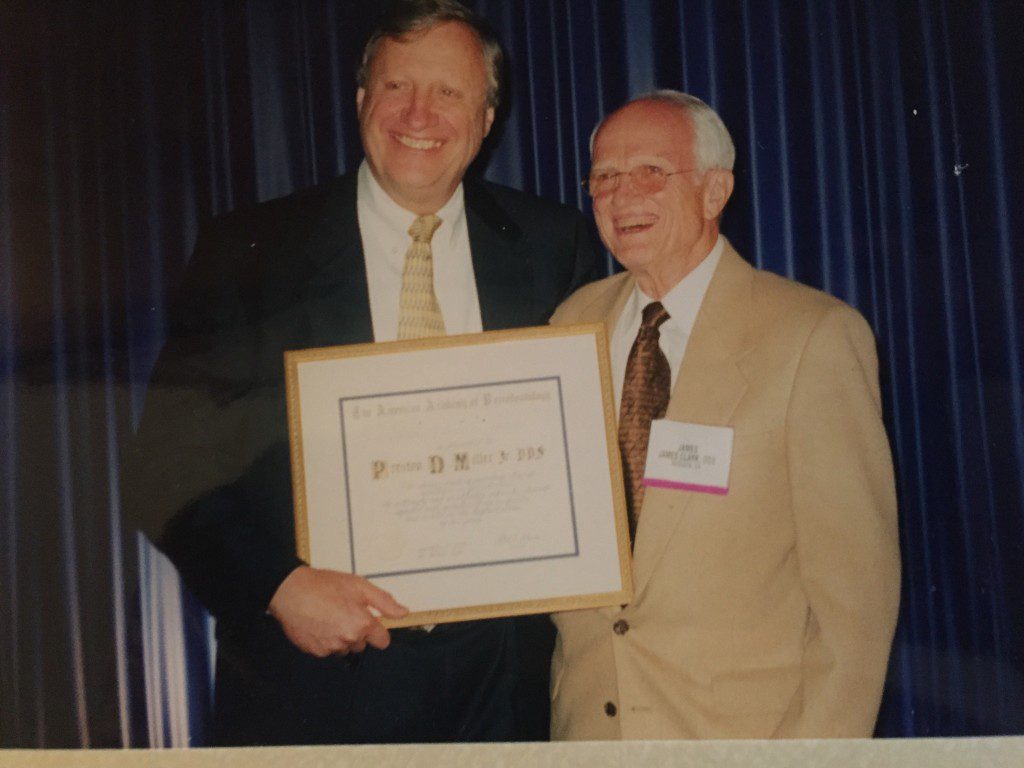
I first met Jim as I began my residency in periodontics in Birmingham in 1967. A smile that stretched from ear to ear revealed teeth that were already worn flat!!!
Jim was a man on a mission-to emphasize that nutrition played a role in periodontal health. I, as a resident, wasn’t interested in nutrition or for that matter, patient evaluation. I had come to Birmingham to learn how to cut gums and grind bone. Osseous surgery, ideal architecture and apically positioned flaps,— now that was what periodontics was all about! Why waste time on diagnosis, patient evaluation, treatment planning and prognosis. All I wanted was to be able to treat—- “talks cheap –lets treat! !My, how Jim and I frustrated each other!!!
Once in a seminar I presented a case where I condemned an erupted maxillary third molar which I extracted during surgery. It was obvious from the x-rays and clinical photos that the tooth needed to come out. No comment was necessary.
Jim stopped me in mid-presentation and asked,what I felt, at the time. was a stupid question, “Why did you remove tooth number 16?” Irked by a question for which the answer was obvious, I smartly replied, “Because it needed to be extracted?” Again Jim repeated, “Why did it need to be extracted?” Stunned and irritated, I unloaded on Jim. “It was non-functional, malposed, covered with plaque; there was a deep pocket on the mesial that was untreatable”, I replied. A brief silence ensued and then Jim calmly replied, “I agree with you, but I just wanted to be sure that you understood the rationale.” Rationale, now , that was what Jim Clark was all about!
Years later I realized that that exchange, was a turning point in my career. Whereas I learned to “do” periodontics in my residency, that confrontation in 1967 was my initation into realizing that diagnosis, patient evaluation,and treatment planning were all necessary to understand prognosis, and that understanding prognosis is the ultimate key to successful treatment. 40 years later I say,” Thank you, Jim, for teaching me a lesson that shaped my career .
Jim’s obituary described him as a scholar-pioneer-humanitarian-educator and a meticulous editor. I agree with all of those. His meticulous and probing mind coupled with a ”bulldog” determination drove me crazy as a resident. Now 40 years later, not a day goes by that I don’t incorporate something in my own teaching that Jim taught me. Like me in 1967, my
residents want to learn how to “do”—especially “do” implants. The interest of todays residents remains the same. Treatment is “the end all –be all” . Diagnosis, patient evaluation and treatment planning are still not a priority. With limited experience they haven’t had time to develop a concept of prognosis. When in doubt , extract and place an implant. When you extract there is no need to consider the prognosis of teeth.
Maybe years later, as today’s residents experience implant cases that fail, perhaps they will reflect, as I have done. and realized that diagnosis, patient evaluation and understanding prognosis are indeed the key to success. Thanks, Jim, for holding my feet to the fire and making me the periodontist that I am. My prayer is that I have the fortitude to “stick by my guns” as you did and not take the easy way out and just teach the residents what they want to know but doggedly teach what they need to know.